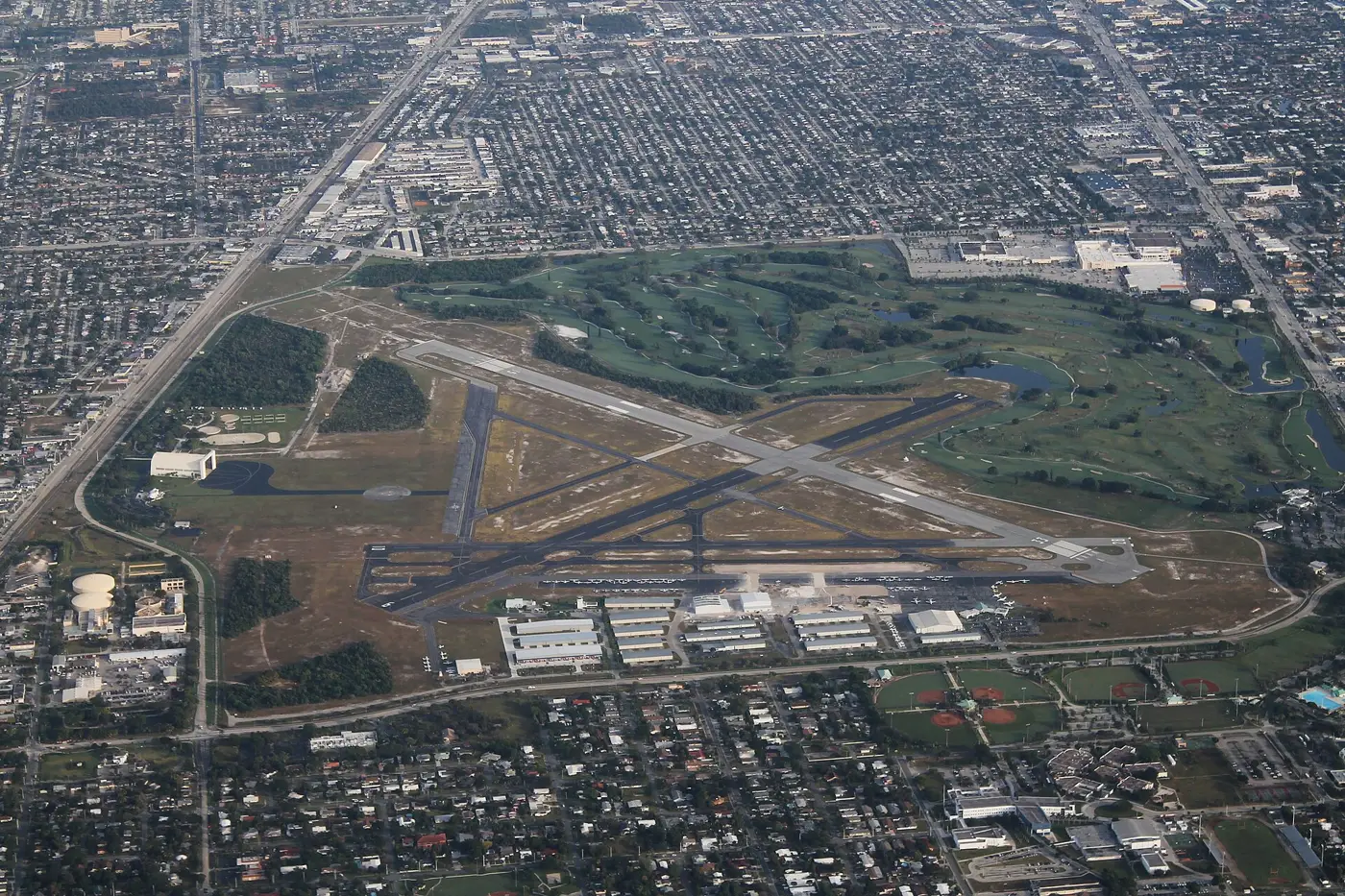
Commissioners voted 6-0 on Oct. 13 to update the Airpark noise map first, about $400,000 to $450,000, instead of ordering the full $1 million FAA study now.
Updated Nov. 2: The commission voted 6-0 on Oct. 13 to update the Airpark’s noise map first, at about $400,000 to $450,000, instead of ordering the full Part 150 study now. Read what the commission decided. The preview below is as published before the meeting.
The Pompano Beach City Commission will discuss Tuesday whether to order a full federal noise study at Pompano Beach Airpark. The agenda for the Oct. 13 meeting puts the fiscal impact at $1 million.
The item asks the commission to direct Airpark staff to carry out an FAA Part 150 noise study. The Public Works Department requested it. It is item 8 on the regular agenda.
The papers attached to the item point the other way. The engineering firm Kimley-Horn told the city’s Airpark staff in September that a full study is unlikely to produce results for residents, and that the Federal Aviation Administration is unlikely to pay for one.
What a Part 150 study is
A Part 150 study is the FAA’s formal process for measuring airport noise and planning ways to reduce it. Kimley-Horn described it in a Sept. 13 email to Airpark staff, which the city attached to the agenda item. The firm said the process:
- is voluntary for the airport’s owner, which here is the city
- runs in two steps: a noise exposure map, then a noise compatibility program, each reviewed by the FAA
- typically takes several years, with any measures phased in over several more
- can open the door to federal money for sound insulation, buying land or noise easements, but only where homes fall inside the noise zone the FAA treats as incompatible
That zone is the 65 DNL contour, a 24-hour average sound level that weights night flights more heavily. The FAA treats homes inside it as incompatible with the airport.
Why the consultant says wait
Kimley-Horn said the Airpark’s 65 DNL contour still sits inside airport property. “There are effectively no FAA-defined noncompatible land uses to address,” the firm wrote.
The firm recommended against reopening the noise maps now. It suggested three cheaper steps instead:
- update the Airpark’s noise contours to see whether the 65 DNL line has moved off airport land
- run the FAA’s Area Equivalent Method, a low-cost screening test of whether activity has changed enough to justify a study
- set up a voluntary “good neighbor” or “Fly Quiet” program with pilots and flight schools
The firm said talks with the Airpark’s flight schools have already begun. It also wrote that Airpark traffic has declined, not grown.
What the last noise map found
The most recent noise study in the agenda papers is the 2016 noise contour update by Hanson Professional Services. It used 2015 figures:
| Measure | 2015 |
|---|---|
| Takeoffs and landings | 142,699 |
| Average a day | 391 |
| Share that was flight training | about 60% |
| Share at night (10 p.m. to 7 a.m.) | 3% |
The 2015 tower records ran January through November, and the study estimated December. It found the 65 DNL contour reached only a small part of the Pompano Beach Baseball Park, which counts as a compatible recreational use.
Lead and fuel questions
The item also follows the Sept. 22 commission meeting. A University of Florida researcher presented a summary of soil lead testing there, and residents spoke in favor of a Part 150 study.
A second Kimley-Horn email, sent Sept. 23, says Commissioner Audrey Fesik asked the city manager to bring a review of the lead summary back to the commission. She also asked about lead testing every 10 years, the EPA’s and the FAA’s views, and whether the Airpark could offer unleaded fuel.
The firm wrote that the source of the lead was not identified at the meeting. It said fuel at the Airpark is sold by its tenants, not the city. It suggested the city ask those tenants to offer an unleaded or low-lead option.
About the Airpark
The city has owned the Airpark since Aug. 29, 1947, the 2016 study says. It was built in World War II as a satellite training field for the Navy. The city took it over under a federal law that requires it to stay in aviation use, or ownership reverts to the FAA. Its traffic ranges from small training planes to the Goodyear Blimp.
What it means for you
- The meeting: 1 p.m. Tuesday, Oct. 13, in the Commission Chamber at City Hall, 100 W. Atlantic Blvd.
- To speak: fill out the “Audience to be Heard” request form in the agenda and hand it to the city clerk before the meeting starts. Speakers get three minutes.
- What could happen: the item is listed for discussion, so the commission may give staff direction instead of approving a contract.
- If you live near the Airpark: neighborhoods that border it include Cresthaven, Avalon Harbor and Downtown and Old Pompano.
We will report what the commission decides. City business is also tracked on our building permits and zoning page and in who to call at City Hall.
Have your say